by Tod Carson | Sep 9, 2026 | All things Antiques
I’ve watched a client walk away from one of the most beautiful bergères I’ve ever sourced — a pristine Louis XV piece with a caned back and its original gilt-wood frame — because I couldn’t hand her more than a bill of sale from the dealer I bought it from. She wasn’t being difficult. She was right. A piece can be exquisite and still be a question mark, and in this business, the paper trail is what turns a question mark into an asset.
Provenance isn’t just “who owned it before.” For 18th-century French furniture, it starts with the maker’s stamp itself, the estampille that guild law required ébénistes to strike into their work once they were accepted into the Jurande des Menuisiers-Ébénistes. No stamp, or a stamp that doesn’t match the construction techniques underneath it, and you’re already asking harder questions. From there it’s inventory records, auction house chain of custody, restoration invoices, even old insurance appraisals — every document that lets you trace a piece backward instead of just trusting the story you were told at the point of sale.
I always tell clients this matters for two reasons, and only one of them is money. Yes, a documented Boulle-attributed commode with an unbroken chain back to a named 19th-century collection will out-appraise an unstamped lookalike every time — pastiche pieces built from genuine period parts are common enough that auction houses now run them through the same scrutiny as outright fakes. But the other reason is quieter: knowing exactly whose hands a piece passed through, what rooms it sat in, what history it witnessed, is half of why we collect furniture provenance at all. Strip that away and you’ve just bought old furniture.
My practical advice, especially for designers specifying pieces for a client’s home rather than their own collection: ask for the dossier before you ask for the discount. A reputable dealer should hand you stamps, invoices, and any prior appraisals, and be honest about the gaps. Keep that paper trail with the piece for its entire life — it travels with the object every time it changes hands again. It’s also exactly what we build for every piece in our collection before it ever reaches a client.
A piece without its papers is a rumor wearing good furniture. Get the paper, and you’ve got history you can actually stand behind.
-Tod Carson
by Tod Carson | Sep 2, 2026 | All things Antiques
Clients ask me all the time how to tell Louis XV vs Louis XVI at a glance, and I always tell them to start at the foot and work up. It sounds too simple, but furniture history really does hinge on that one detail. Louis XV, roughly 1730 through the 1760s, is the reign of the curve — asymmetrical rocaille carving, serpentine cabriole legs that seem to bend under their own weight, no straight line in sight if the ébéniste could help it. Louis XVI, which took hold after 1774, is the reign that put the ruler back on the workbench. The excavations at Pompeii and Herculaneum had just reintroduced Europe to classical antiquity, and cabinetmakers responded by squaring everything off: tapered, fluted legs, often finishing in a little spinning-top foot the French called a pied toupie.
The mounts tell the same story in miniature. On a Louis XV commode you’ll find gilt bronze that mimics rockwork and shell forms, applied asymmetrically because symmetry was considered stiff. On a Louis XVI piece the ormolu turns disciplined — paterae, ribbon-and-swag, husk garlands, everything mirrored down the centerline. I think about Georges Jacob a lot when I explain this, because he’s the craftsman who proves the shift wasn’t just fashion, it was survival. Jacob trained under the old guild system as a menuisier, built his early reputation on Louis XV seating full of movement and shell carving, and then pivoted his workshop almost overnight when Marie Antoinette’s taste for neoclassicism took over Versailles. The chairs he made for her at the Petit Trianon are about as far from rocaille as furniture gets, and he never missed a beat.
I had a client last year send me photos of a bergère she’d bought at an estate sale, convinced it was Louis XV because someone at the sale told her so. I didn’t even need to see the maker’s stamp — the leg was straight and fluted, tapering to a toupie foot, which put it a good generation later than she thought. That’s not a small distinction when you’re pricing a piece or specifying it for a room with a particular architectural language. A Directoire-leaning interior with crisp millwork will fight with a serpentine Louis XV settee every time, and a designer who can read the silhouette from across the room saves everyone a lot of second-guessing.
None of this is trivia for its own sake — it’s the difference between decorating a room and understanding one. I keep several pieces from both periods in our collection specifically so clients can put a hand on the actual curve or flute and feel the difference themselves, which teaches the eye faster than any photograph. Read the leg first. The rest of the piece will tell you if you were right.
-Tod Carson
by Tod Carson | Jul 17, 2026 | All things Antiques
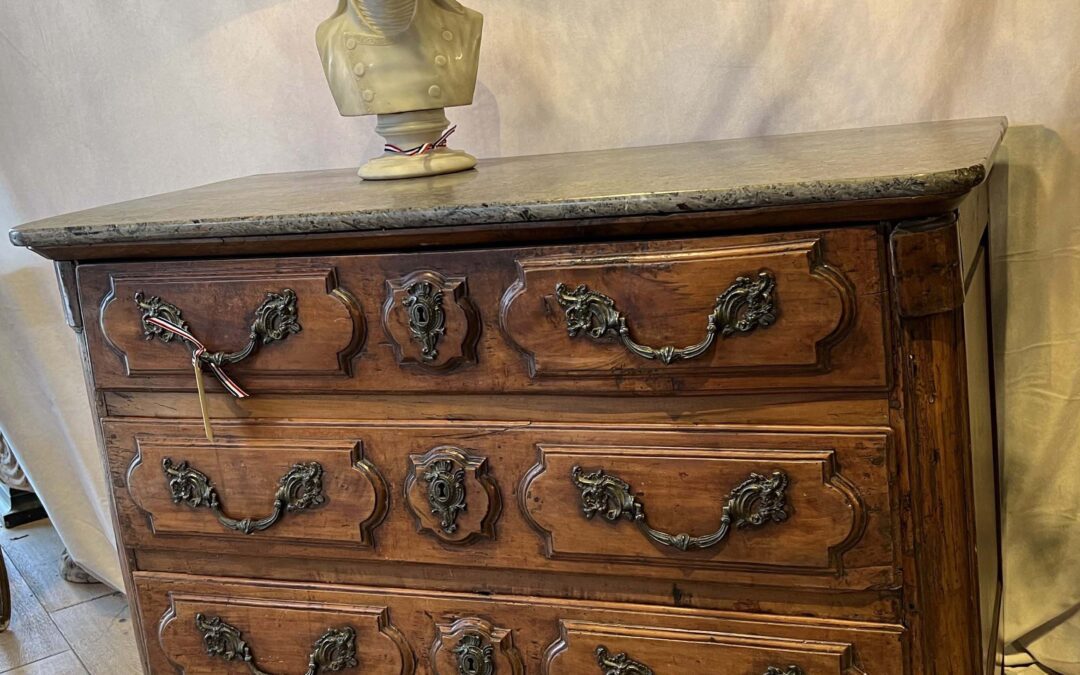
For anyone assembling a serious collection of 18th-century French furniture, learning to authenticate a commode is not optional homework, it is the foundation everything else is built on. The difference between a museum-quality piece and a well-made later copy often comes down to details most buyers never learn to look for. Start with the stamp: after 1743, French guild law required master cabinetmakers, the maitres-ebenistes, to stamp their work with their name, typically on the back rail or underside of the carcass, alongside the JME mark of the Jurande des Menuisiers-Ebenistes guild. Names like Riesener, Leleu, and Carlin still command attention today precisely because their stamps can be verified against guild records. A crisp, correctly placed stamp is reassuring, one that looks too fresh, or sits somewhere a genuine maker never signed, is a signal to look closer.
Construction and hardware tell the rest of the story. Genuine 18th-century case pieces were built from solid oak or pine carcasses, hand-cut dovetails, and veneers laid by hand, irregular, slightly uneven, honest. Machine-cut dovetails, uniform veneer thickness, or plywood backing are 19th or 20th century tells, no matter how convincing the surface looks. Run a hand along the underside and the back, that is where restorers rarely bother to disguise their work. The bronze mounts deserve the same scrutiny: mercury-gilt ormolu, hand-chased and fitted individually to each piece, has a warmth and depth electroplated reproductions cannot replicate. Hand-fitted mounts show slight individual variation from piece to piece, while cast reproduction sets are often identical to the millimeter.
Then there is provenance, which matters as much as the physical evidence. A documented chain of ownership, prior auction records, a published catalogue raisonne, a family history that can be traced, does more than support value, it corroborates everything the stamp and construction are telling you. I always tell clients to buy the paper trail as seriously as they buy the piece. A commode without provenance can still be genuine, but one with a strong provenance is a piece you can defend for the next fifty years.
None of this replaces expertise. A trained eye, ideally one that has handled hundreds of pieces across decades, will catch what photographs and checklists cannot. But knowing what to look for changes the conversation you have with a dealer, and it should. A great commode does not need convincing. It simply needs to be understood. If you’re drawn to pieces like this one, browse our current collection to see what’s in the showroom now.
-Tod Carson
by admin | Jan 16, 2026 | All things Antiques
Among the many French decorative movements of the 18th to 20th centuries, the Louis XVI period (circa 1774–1793) remains one of the most enduringly collected along with my personal favorite. Emerging as a deliberate rejection of Rococo excess, Louis XVI design marked a return to order, proportion, and classical restraint.
Inspired by the archaeological rediscoveries of Pompeii and Herculaneum, French artisans embraced Neoclassicism with academic seriousness. Furniture forms became rectilinear and balanced, replacing serpentine curves with straight, fluted legs and architectural clarity. Ornamentation was still present, but it behaved itself—think laurel wreaths, rosettes, urns, and Greek key motifs rather than shellwork and froth.
Craftsmanship during this period reached an extraordinary level. Cabinetmakers such as Jean-Henri Riesener and Georges Jacob produced pieces that were not only visually refined but structurally sound, built to endure centuries of use. Mahogany, walnut, and fruitwoods were carefully selected, often accented with finely chased gilt bronze mounts. Marquetry became more restrained, favoring geometric patterns over pictorial excess.
What makes Louis XVI antiques particularly compelling to modern collectors is their architectural compatibility. These pieces sit comfortably in both traditional interiors and contemporary spaces, offering quiet authority rather than theatrical presence. A Louis XVI commode or fauteuil does not demand attention—it earns it.
As France moved into the 19th and early 20th centuries, the influence of Louis XVI design persisted, reinterpreted during the Directoire, Empire, and later revival periods. Even today, many high-quality reproductions and reinterpretations continue to draw directly from Louis XVI proportions, a testament to the movement’s fundamental correctness.
In an age obsessed with novelty, Louis XVI antiques remind us that restraint, symmetry, and honest craftsmanship never go out of style. These are not pieces meant to shout across a room. They are meant to last—physically, aesthetically, and culturally.
If Rococo was a conversation, Louis XVI was a conclusion.
by admin | Oct 24, 2025 | All things Antiques
Spotlight on popular French European antique styles
France has long been synonymous with elegance, sophistication, and artistic innovation, and its influence on the world of design and decorative arts is undeniable. From the opulent grandeur of the Baroque period to the graceful simplicity of Art Deco, French styles and movements have left an indelible mark on the history of antique furniture and design. In this blog, we’ll embark on a journey through some of the most iconic French styles and movements, celebrating their enduring allure and timeless beauty.
- Baroque Splendor: Originating in the 17th century, Baroque art and design in France were characterized by their grandeur, drama, and ornate embellishments. Influenced by the reign of Louis XIV, the Sun King, Baroque furniture featured lavish carvings, gilding, and richly upholstered fabrics. Pieces such as elaborately carved armoires, imposing commodes, and intricately detailed mirrors epitomized the opulence of the era, showcasing the craftsmanship of French artisans at its zenith.
- Rococo Romance: Building upon the exuberance of the Baroque period, the Rococo style emerged in 18th-century France with its emphasis on elegance, lightness, and playful ornamentation. Rococo furniture was characterized by its sinuous curves, delicate motifs inspired by nature, and pastel-colored finishes. Exquisite examples include Louis XV-style armchairs adorned with delicate floral carvings, graceful console tables adorned with scrolls and shells, and whimsical commodes featuring asymmetrical designs.
- Neoclassical Refinement: With the dawn of the 19th century came the Neoclassical revival, inspired by the archaeological discoveries of ancient Greece and Rome. French Neoclassical furniture was marked by its clean lines, geometric forms, and restrained ornamentation. Influenced by the reign of Louis XVI and the ideals of the Enlightenment, Neoclassical pieces exuded a sense of refinement and symmetry. Iconic examples include elegant bergères with straight, fluted legs, neoclassical-style desks adorned with tapered columns, and graceful guéridons featuring marble tops and classical motifs.
- Art Nouveau Innovation: In the late 19th and early 20th centuries, France was at the forefront of the Art Nouveau movement, which sought to break free from the constraints of historicism and embrace organic forms and flowing lines. Art Nouveau furniture was characterized by its sinuous curves, nature-inspired motifs, and innovative use of materials such as bentwood, stained glass, and inlaid marquetry. Striking examples include the iconic designs of Émile Gallé, featuring intricate floral marquetry, and the sinuous lines of Hector Guimard’s famous Paris Métro entrances.
- Art Deco Glamour: Emerging in the 1920s, the Art Deco movement epitomized the modernist spirit of the Jazz Age, blending geometric forms, exotic materials, and luxurious finishes. French Art Deco furniture was characterized by its sleek lines, bold geometric shapes, and lavish use of materials such as lacquer, chrome, and exotic woods. Striking examples include the iconic designs of Émile-Jacques Ruhlmann, featuring elegant curves and exquisite craftsmanship, and the geometric patterns of Jacques-Émile Ruhlmann’s luxurious interiors.
In conclusion, the rich tapestry of French styles and movements reflects the nation’s enduring commitment to artistic excellence and innovation. From the ornate splendor of the Baroque period to the sleek glamour of Art Deco, each era has left its own distinctive imprint on the world of antique furniture and design, captivating collectors and enthusiasts alike with its timeless elegance and enduring beauty.
by admin | Sep 24, 2025 | All things Antiques
Empire furniture, the bold and grand style that emerged in France during the reign of Napoleon Bonaparte (1804-1814), remains a symbol of power, elegance, and sophistication. Characterized by its strong, imposing forms and lavish detailing, Empire furniture appeals to collectors and connoisseurs who appreciate its rich history and artistry. But what exactly makes a piece Empire? Here’s a guide to help you identify key features of this distinctive style.
1. Strong, Monumental Forms
One of the most striking characteristics of Empire furniture is its emphasis on bold, geometric lines and strong, monumental forms. Unlike the softer curves of earlier styles like Rococo, Empire pieces tend to be more angular and imposing, reflecting the Napoleonic ideals of strength and grandeur. Chairs, tables, and cabinets often feature wide, straight lines and a solid, grounded appearance, meant to convey authority and status.
2. Regal Motifs and Ornate Detailing
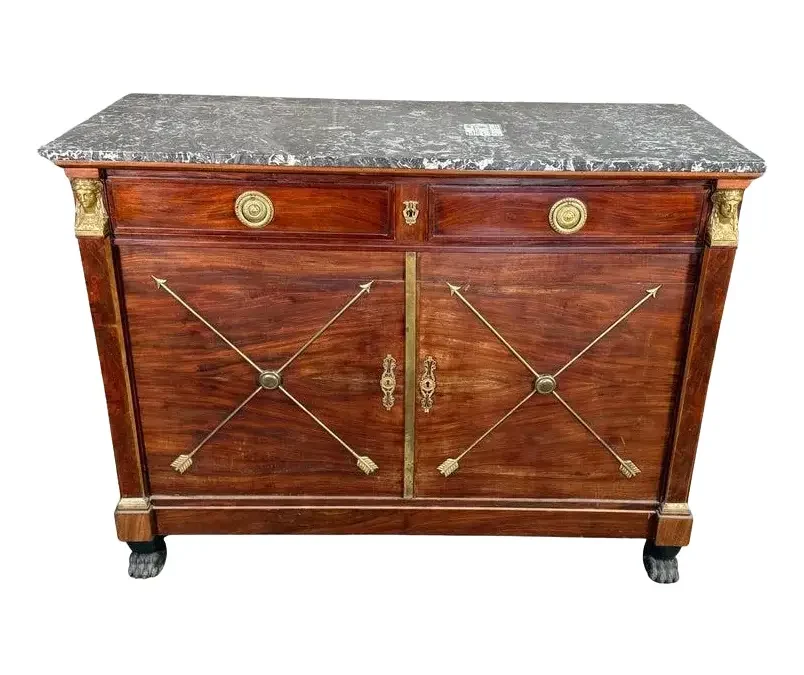
Empire furniture is rich with symbolism. Napoleon himself was deeply invested in the visual language of power, and the furniture of his era reflects this. Look for motifs like eagles (representing imperial power), sphinxes (symbolizing mystery and authority), and laurel wreaths (denoting victory). Bronze ormolu (gilded bronze) is often used to accentuate these motifs, with intricate detailing such as lion paw feet, garlands, and fluted columns.
3. Rich, Exotic Woods
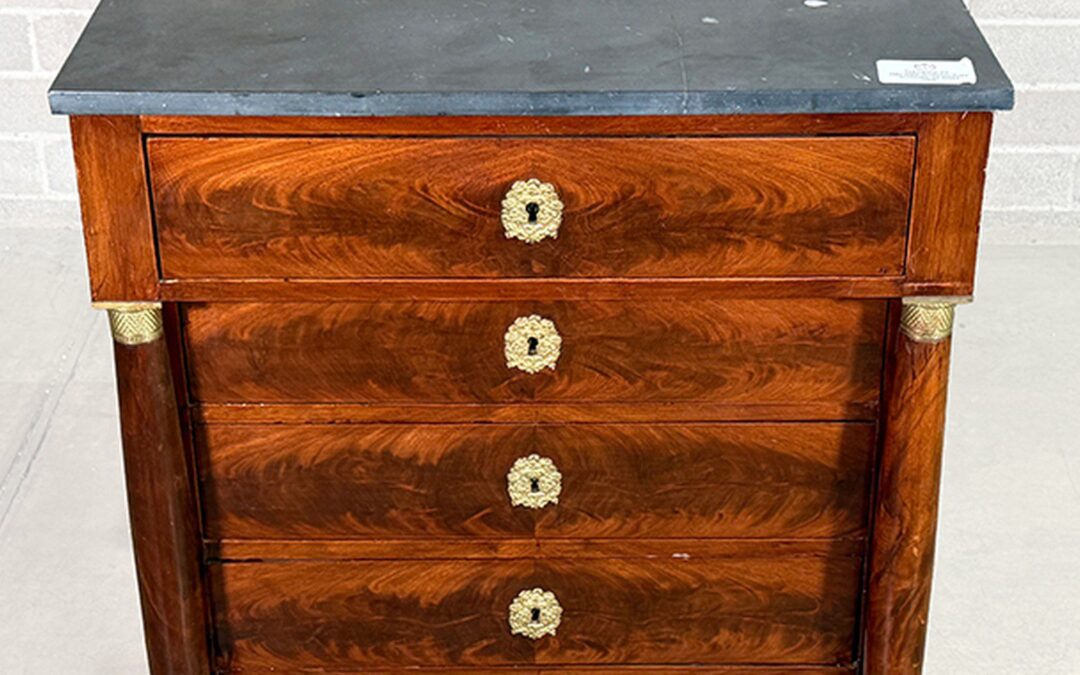
The woods used in Empire furniture are often darker and more luxurious than those seen in earlier periods. Mahogany is the wood of choice, prized for its deep, reddish-brown tones and fine grain. In addition to mahogany, ebony and other exotic woods were used for inlays, creating striking contrasts with the larger, solid surfaces. This use of rich materials speaks to the wealth and power of the period.
4. Classical Influence
Empire furniture draws heavily from classical antiquity, especially from Roman and Greek art and architecture. Columns, pediments, and even classical urn shapes often feature in the design of cabinets, side tables, and mirrors. The furniture style also incorporates Roman and Greek motifs such as fluted columns and acanthus leaves, evoking the grandeur of ancient civilizations while also serving to reinforce Napoleon’s self-image as a leader of historical significance.
5. Bold Upholstery and Fabrics
Upholstered Empire furniture, such as sofas and chairs, often uses sumptuous fabrics like velvet, silk, or damask, in deep, rich colors such as crimson, dark blue, or gold. The upholstery is typically more structured and stiff than earlier styles, contributing to the overall bold, formal aesthetic. Embroidered or woven patterns may feature classical motifs or even military emblems, further reinforcing the imperial theme.
6. Furniture Pieces in Empire Style
Common pieces found in the Empire style include consoles, commodes, sideboards, tables, and armchairs. One of the most iconic pieces of Empire furniture is the fauteuil (a type of armchair), often featuring straight lines and bronze mounts. Secretaire desks and armoires were also popular, with large, imposing forms and decorative bronze hardware.
7. Gold and Brass Accents
Gold was a frequent feature in Empire furniture, often used to highlight the richness of the wood and to add an air of regality. This could be in the form of bronze mounts, gilded details, or even entire sections of gold leaf. Brass inlays or ornaments also helped to further elevate the furniture, reflecting the opulence of the period.
In Conclusion
Empire furniture is defined by its boldness, opulence, and strong connection to classical antiquity. It combines grandeur with a focus on imperial power, making it a timeless symbol of sophistication and strength. When identifying Empire pieces, focus on the geometric forms, rich materials, and symbolic embellishments. Whether you’re looking to add to your collection or simply appreciate the artistry of this iconic style, understanding the key features of Empire furniture will deepen your appreciation for these majestic and historic pieces.